





How to Choose the Right Marketing Agency in Florida (2026 Guide)
December 15, 2025
In-House Marketing vs Agency: 2026 Florida Business Guide
February 8, 2026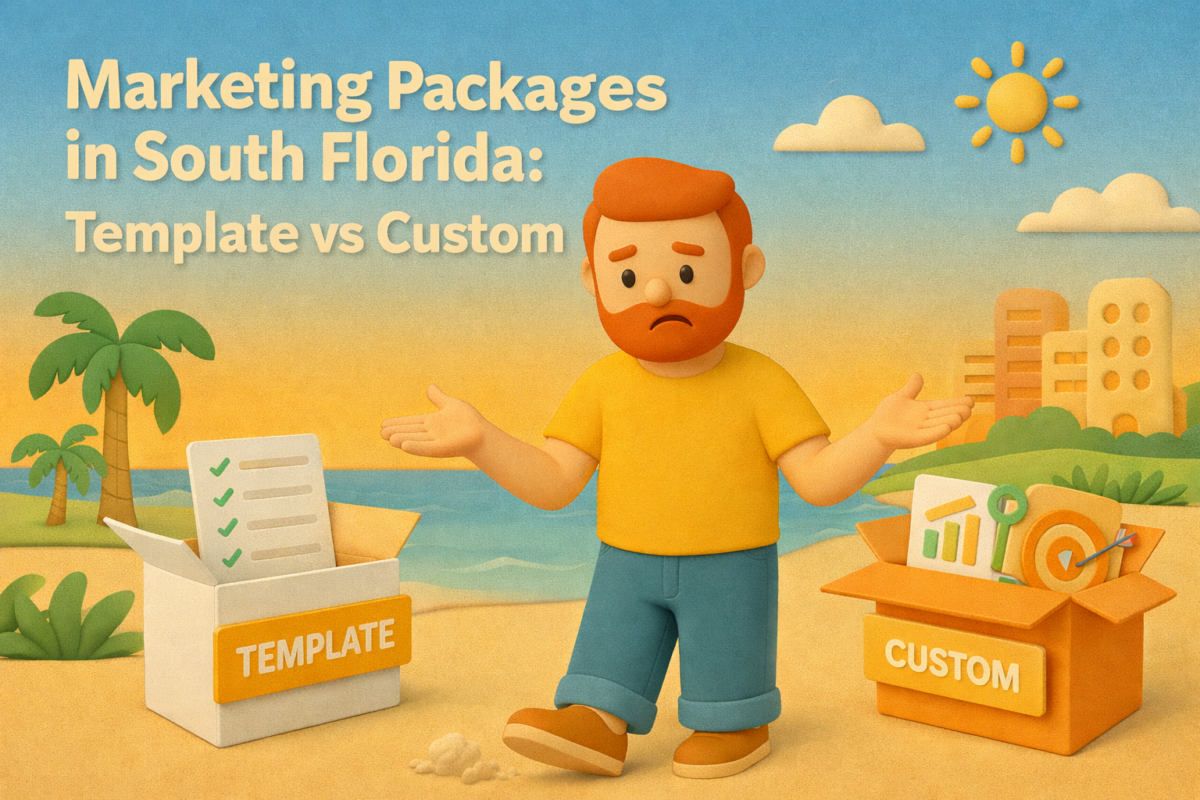
Marketing Packages in South Florida: Template vs Custom
Introduction
Choosing a marketing partner in South Florida often comes down to a tough decision: Do you go with a pre-set marketing package, or do you invest in a custom strategy tailored just for you? If you’ve been searching for digital marketing help in Miami, Fort Lauderdale, West Palm, or anywhere in between, you’ve probably seen agencies advertising flat-rate “packages” (like a Bronze/Silver/Gold plan with specific deliverables). You’ve likely also talked to firms that don’t publish fixed packages, insisting on a custom proposal after hearing about your business.
For service-based businesses, e-commerce brands, and law firms in our region, it’s crucial to understand what you’re actually buying. The goal of this article is to educate buyers on templated packages vs. custom strategies, so you can set the right expectations before you sign on with a marketing agency. We’ll also share common pricing ranges in South Florida for services like SEO and PPC management, so you can budget realistically. By the end, you should have clarity on which approach fits your needs and you’ll know how to avoid solutions that sound cheap up front but fail to deliver meaningful results.
(Quick note: At J. Oliver Advertising, we’ve structured our services around custom, prescriptive strategies – but we’ll be the first to tell you that templated packages aren’t inherently “bad.” They have a place for certain situations. The key is recognizing when a simple package is enough and when your business requires more.)
TL;DR: Too Long, Didn’t Read.
South Florida is a highly competitive market (Palm Beach, Broward, Miami-Dade), so understanding marketing packages vs. custom strategies matters before choosing an agency.
Templated marketing packages offer fixed deliverables at a fixed price.
- Simple, predictable, and budget-friendly
- Best for basic needs or very limited budgets
- Limited flexibility and weaker performance in competitive markets
Custom (prescriptive) marketing strategies are built around your specific business goals, audience, and local competition.
- Adapt to your market and growth objectives
- Perform better when competition is high or multiple channels are needed
- Ideal for businesses serious about scaling
Typical South Florida agency pricing ranges:
- SEO retainers: $1,000–$5,000/month for small-to-midsize businesses (more for larger or multi-location campaigns)
- PPC management: 10–20% of ad spend, often with minimum monthly fees in the few-hundred-dollar range
- Full-service digital marketing (SEO, PPC, social, content, etc.): $3,000+/month, with many businesses investing $5,000–$15,000/month for comprehensive growth
Bottom line:
- If you’re a service business, e-commerce brand, or law firm investing $1,000+/month and targeting meaningful growth, a custom strategy will align far better with your goals than any one-size-fits-all package.
- If your needs are very simple or your budget is below that range, a templated package can handle the basics—just keep expectations realistic.
Not sure what you need? J. Oliver Advertising offers a Free Full Digital Marketing Audit to qualified businesses.
👉 Request a Free Digital Audit(best for businesses investing $1k+/month)
After a quick 15-minute discovery call, our team will review your SEO (technical setup, on-page factors, local listings, content gaps), Google Ads & PPC (account structure, keywords, ad copy, budgets, conversion tracking), website (UX, speed, conversion opportunities), and even do a high-level competitive snapshot. We’ll then share a customized report of findings with clear recommendations, no cost, no obligation. (This audit is most helpful for businesses already spending at least about $1,000 per month on marketing.)
What Are Templated Marketing Packages?
“Templated” marketing packages refer to pre-defined sets of services that an agency offers for a fixed monthly price. Think of it as a menu deal: you pay $X per month and you get list A, B, C deliverables. For example, 4 blog posts, 10 social media posts, and 2 email blasts for $2,000/month. These packages are often tiered (e.g. Starter, Pro, Deluxe) and are presented the same way to every client.
Why do these packages exist? They make marketing services easier to sell and buy. For a busy small business owner with a tight budget, a clear package is convenient. You immediately know what you’ll get each month. Agencies, in turn, can templatize their work, manage their team’s time in a predictable way, and quickly onboard clients without building a strategy from scratch every time. In South Florida, you’ll find many agencies (and even freelancers) offering bundled packages targeting small businesses who want a predictable cost and a tidy list of outputs.
Pros of templated packages:
- Simplicity & Predictability: You know exactly what deliverables you’ll receive and what it will cost. This can be comforting if you’re new to marketing or have a very strict budget. For example, a local Palm Beach County boutique might sign up for a package that clearly outlines, say, 15 Instagram posts and basic SEO each month for $500, easy to understand with no surprises.
- Lower Up-Front Cost: Packages are often priced lower than a full custom plan. They’re designed to be affordable entry points. If your business has very basic needs (like just setting up a website and some social profiles) or you’re in a low-competition market, a small package can cover those essentials without breaking the bank.
- Quick Start: Since the services are pre-defined, the agency can start executing right away. There’s usually less discovery or planning needed. For example, a templated “Local SEO Package” might immediately kick off with listing your business on directories and doing on-page SEO, without needing weeks of research.
Cons of templated packages:
- One-Size-Fits-All: By nature, a preset package assumes every business needs the same things. But your business is unique – your market, customers, and goals likely differ from others. A generic package might include some activities that aren’t very useful for you, while missing important tactics that you do need. (E.g., the package might allocate time to weekly Facebook posts, when maybe your audience is actually more active on LinkedIn or email – meanwhile it might neglect something crucial like improving your website’s call-to-action that you specifically need.) Additionally, it might be best to do the opposite of what your competitors are doing. For example, if your market is highly competitive with majority of your competitors having strong SEO, but they lack in content marketing or ad campaigns, then this can be an entry point you succeed in.
- No Deep Strategy or Flexibility: Templated plans usually skip the strategy phase. They typically don’t start with a thorough analysis of your market or competitors; they just start doing the predefined tasks. Moreover, they’re not very flexible month-to-month, you get the same deliverables regardless of shifting market conditions or campaign performance. If the package promises 4 blog posts a month, you’ll get 4 blog posts even if, say, it would have been better to spend that time adjusting your Google Ads or creating a sales page during that month. The rigid scope can lead to stagnation, the marketing keeps churning, but it might not be moving the needle.
- Focused on Activities, Not Outcomes: Packages tend to emphasize quantity of deliverables (“we’ll do X, Y, Z each month”). But more activity doesn’t automatically mean more results. It’s possible to check all the boxes (blogs written, posts published, dollars spent on ads) and still see flat results if those tactics weren’t the right ones for your situation. With a templated package, it’s easy to fall into a pattern of “we did our list of tasks, so we’re done,” without someone actively questioning whether those tasks are achieving your revenue or lead-gen goals.
In short, templated packages trade customization for convenience. They can work fine for small businesses with straightforward needs, for example, a single-location café or a solo realtor might just need a basic online presence and occasional posts, which a low-cost package can handle. However, as we’ll explore, when your goals are more ambitious or your environment more competitive, a static package is likely to disappoint.
What Is a Custom Prescriptive Marketing Strategy?
A custom marketing strategy (what we also call a prescriptive strategy) is the opposite of one-size-fits-all. Instead of starting with a list of deliverables, it starts with your business – your goals, your challenges, your market – and builds a plan around that. A good agency crafting a custom strategy will usually begin with a lot of questions and research: Who is your target customer? What are your revenue goals? Who are your competitors in South Florida (and beyond)? What marketing have you tried before, and what were the results? Are there any industry regulations or special considerations (for instance, advertising rules for law firms or medical practices)?
From these inputs, the agency prescribes a set of marketing initiatives designed specifically to achieve your goals within your constraints. It’s like going to a doctor for a personalized treatment plan, rather than buying medicine off the shelf that “most people” take. A custom strategy might say, for example: Based on your situation, we’re going to focus heavily on LinkedIn ads targeting professionals in Miami, scale back on broad social media, invest in SEO content around these 10 high-value keywords, and run a re-marketing campaign, because that mix is most likely to hit your objectives. The next step is then executing that plan, with room to adjust as data comes in.
Pros of custom strategies:
- Tailored to Your Goals & Market: Everything being done has a clear rationale tied to your business. If you’re a law firm seeking marketing in Fort Lauderdale, a custom plan will account for legal ad rules, high cost-per-click keywords in law, and the need for content that builds authority with potential clients. If you’re an e-commerce fashion brand in Miami, the strategy might focus on Instagram and TikTok advertising, influencer partnerships, and conversion rate tweaks on your online store, because those will matter most for you. Nothing is done just because “it’s in the package”; it’s done because it’s the right move for your situation.
- Flexibility & Ongoing Optimization: Custom engagements typically involve ongoing monitoring and adjustment. The agency is continuously looking at results and can pivot tactics as needed. For example, if after a couple of months the data shows your SEO is yielding better ROI than your Facebook Ads, they can recommend shifting more resources into SEO or vice versa. The marketing plan is a living strategy that can adapt to market changes (seasonality, new competitors, algorithm updates, etc.). This agility is critical in dynamic markets like South Florida, where trends can shift with the influx of new residents and businesses.
- Focus on Outcomes, Not Just Activities: A quality custom strategy keeps the focus on your business outcomes, more leads, more online sales, higher client acquisition, etc. The agency will set KPIs (key performance indicators) that track those outcomes, and they’ll regularly review progress with you. Instead of simply reporting “we did X and Y this month,” a custom approach will report “here’s what those activities achieved – e.g., your organic traffic grew 20%, or your cost per lead dropped by half.” In other words, you’re paying for expertise and results, not just busywork. Also, because the plan is goal-first, if something isn’t working, the plan can change. You’re effectively buying a partnership with marketing experts, rather than a fixed product.
Cons of custom strategies:
- Higher Cost & Commitment: Developing and executing a custom marketing plan typically requires a larger investment than buying a small pre-defined package. You are paying for the agency’s time to deeply research and strategize, as well as possibly a broader scope of work. It’s not a “quick fix” or commodity service, it’s more like hiring a fractional marketing team. For many businesses, this makes sense when marketing is a growth engine they’re ready to fuel. But if your budget is very limited or you just need a couple of basic tasks done, a full custom engagement may be more solution than you need (or can afford) at the moment. In South Florida, serious custom digital marketing retainers often start around a few thousand dollars a month and go up from there, depending on how many channels and how aggressive the goals are.
- Takes More Collaboration: A custom strategy can require more involvement from you, the client. Since the agency isn’t just pulling a ready package off the shelf, they will need your input and feedback to craft and adjust the plan. Expect strategy meetings, detailed questions, and ongoing check-ins. For busy entrepreneurs, this is usually a worthwhile investment of time (after all, you get a plan that actually fits your business), but it’s good to be aware that your insight and participation will be part of the process. By contrast, with a templated package you might just sign up and get reports periodically without much interaction (though that’s also a downside, as we noted).
In summary, a custom strategy is about having the right marketing plan for you rather than a generic plan for everyone. It’s prescriptive: the agency diagnoses what will help your specific business grow and allocates your budget accordingly. Reputable agencies that operate this way also tend to be transparent about how they charge (often separating their management fees vs. your ad spend, which we’ll explain shortly) and they won’t promise “guaranteed results”, instead, they commit to continuously optimizing toward your goals.
Templated vs. Custom: Key Differences at a Glance
To crystallize the differences between a templated package and a custom strategy, let’s compare them side by side on a few major points:
| Aspect |
Templated Marketing Package
|
Custom Marketing Strategy
|
|---|---|---|
| Approach | Pre-set deliverables and tactics applied to many clients in a similar way. Little to no initial research on your unique situation. | Strategy-first and goal-driven, crafted from scratch for your business after research. Tactics are chosen based on what will move the needle for you.
|
| Flexibility | Rigid scope. You receive the same list of services every month. Limited ability to adapt to new opportunities or challenges without upgrading to a different package. | Highly flexible. The plan can change as needed. If data shows something isn’t working or a new opportunity emerges, the strategy shifts to address it (e.g., reallocating budget between channels). |
| Customization | One-size-fits-all. Minimal tailoring to individual business nuances. Two companies in different industries might get a very similar package. | Fully personalized. Considers your industry, target audience, competition, compliance requirements, etc. For instance, a medical clinic’s strategy will look very different from a retail store’s, by design. |
| Pricing Structure | Fixed price. Often lower cost. May bundle a fixed amount of work or set of deliverables for that price. Easy to understand, but you get what you pay for (scope is limited). | Variable price. Based on scope and expertise. Typically a monthly retainer or project fee aligned with the level of effort and resources needed. You pay for the time/skills of an expert team, not just a checklist of tasks. |
| Best Suited For | Small budgets & basic needs. New or very small businesses that just need an online presence or a steady trickle of marketing activity. Also low-competition scenarios where doing the “bare minimum” is enough to stay on par. | Competitive markets & growth-focused goals. Businesses that need to stand out in a crowded field (law, finance, real estate, etc.), have multiple marketing channels to manage, or require integration (ex: CRM tracking, complex funnels). Also necessary for industries ere messaging and strategy must be handled carefully. |
| Pros Summary | Simple and predictable. Lower cost entry point. Quick to launch without much planning. You know exactly what you’re getting. | Tailored and effective. Focuses on what will actually drive results for you. Can adapt over time. Holistic approach that ties all marketing efforts to your specific objectives. |
| Cons Summary | May not address your real goals. Can waste resources on activities that aren’t impactful for you. Doesn’t adapt to change, risking stagnation. Essentially, you’re buying tasks, not strategy. | Requires bigger investment. Involves more collaboration and trust. Not necessary for very basic needs. You have to commit to a process and give it time to see full results (no “magic overnight fix”). |
As the table shows, neither approach is “universally right” or wrong, it depends on your context. Let’s explore a couple of concrete scenarios to make this even clearer.
Example Scenarios: When to Use a Package vs. When to Go Custom
To illustrate the concepts, consider these real-world style scenarios:
Example 1: When a Templated Package Makes Sense
Scenario: Joe runs a small air-conditioning repair business in Broward County. He’s basically a one-man operation with a part-time assistant, serving a few local towns. Joe has gotten most of his customers through word-of-mouth, but he knows he needs some online presence, a Google Business listing, maybe a simple website with his phone number, and a way to show up when someone searches “AC repair near me” in his area. His marketing budget is very limited (a few hundred dollars a month, at most).
Solution: Joe finds a local agency offering a “Local Business Starter” marketing package for $500/month. The package includes setting up or optimizing his Google Business Profile (Google My Business), basic SEO for his one-page website, and managing a small Google Ads campaign capped at $300 ad spend per month targeting his service area. It also promises two Facebook posts a week featuring HVAC tips (pulled from a content library). This is a clearly defined, templated package.
Why it works for Joe: This package isn’t going to catapult Joe to dominate the whole South Florida HVAC market, but Joe doesn’t need that. It covers the basics that he had no time or expertise to handle: now his business appears on Google Maps for local searches, his website has the key information and some relevant keywords, and a modest PPC campaign ensures he’s visible for a few important search phrases (like “AC repair Pompano Beach”). The Facebook posts keep his page active so it doesn’t look abandoned. All of this is done without Joe having to strategize; it’s the same package many local plumbers, electricians, and handymen use, and it’s sufficient for a business of his size to be in the game. The fixed price is within his budget, and he appreciates knowing exactly what he’ll get each month.
Limitations to note: If Joe decides next year that he wants to expand his business or if a new competitor comes to town running aggressive marketing, this package will likely hit its ceiling. He might notice that beyond a certain point, the leads plateau because the package doesn’t include, say, content marketing or more advanced ad strategies that bigger competitors will use. Also, some of the deliverables (those Facebook posts) may not be bringing Joe much new business, but they are in the package regardless. In Joe’s case, that’s okay for now. The templated approach served as a starter solution to establish an online foundation at minimal cost. Down the road, if Joe grows or competition heats up, he should be ready to graduate to something more custom.
Example 2: When a Custom Strategy is Required
Scenario: Smith & Lopez is a law firm with offices in Miami and Fort Lauderdale. They specialize in personal injury and medical malpractice cases. The South Florida legal market is extremely competitive, dozens of firms are vying for the same clients, and those clients are valuable (a single case could be worth tens of thousands in fees). The firm’s partners have set an ambitious goal to increase qualified leads from the web by 50% this year. They have a healthy marketing budget to invest, but every dollar needs to count. Moreover, legal advertising is subject to compliance rules (Florida Bar regulations), things like referral language and testimonials in ads have strict guidelines.
Initial approach & issues: Initially, Smith & Lopez tried a marketing “Gold” package from a generalist agency: it promised a bit of everything, 4 blog posts a month, managing $2,000 in Google Ads spend, some SEO link building, and a monthly analytics report, all for a flat fee. After six months, the firm saw only a small uptick in website traffic and almost no improvement in the actual leads calling in. Why? The package delivered generic law articles for their blog and ran some basic Google Ads across broad keywords like “Miami personal injury lawyer,” but it wasn’t aggressive or sophisticated enough for this highly competitive field. Essentially, the firm was spending money on a scattershot of tactics that weren’t moving them closer to their lead goal. The deliverables were getting done, but the strategy wasn’t targeted to outshine serious competitors.
Switching to custom: Realizing this, Smith & Lopez pivot to an agency (let’s say, J. Oliver Advertising 😉) that insists on creating a custom strategy. The agency starts with a full audit of the firm’s online presence and competitors. They discover, for example, that competitors are investing heavily in content – some have hundreds of pages of SEO-optimized articles and guides. Competitors also run sophisticated ad campaigns with dedicated landing pages for specific case types (car accidents, medical malpractice, etc.), and some are doing local service ads and extensive review management. Simply posting a few generic blogs and running a minimal ad campaign was never going to cut it.
The custom plan: With all this data, the agency crafts a multi-pronged strategy for Smith & Lopez:
- SEO Strategy: Focus on creating high-quality, authoritative content on very specific topics (e.g., “What to do after a car accident in Miami” or “How medical malpractice claims work in Florida”) to rank well in organic search. Optimize existing pages to load fast and meet technical SEO best practices. Build authoritative backlinks via legal directories and partnerships. Also, optimize each office’s Google Business Profile for local searches like “Fort Lauderdale injury attorney.”
- Content & Compliance: Every piece of content and ad copy is reviewed for compliance with legal advertising rules, ensuring no claims like “#1 law firm” that the Bar would disallow. The messaging is tailored to the firm’s strengths (e.g., highlighting their combined years of experience and successful case results in a factual, approved manner).
- PPC Strategy: Instead of a broad, low-budget campaign, they allocate a significant ad budget (let’s say $10,000+/month) across targeted Google Ads campaigns, one for car accidents, one for slip-and-fall, one for malpractice, etc., each with tailored keywords and ad copy that speaks to those specific injuries. They also set up remarketing ads to stay in front of people who visited the site but didn’t call, and Bing search ads to not miss that smaller portion of users. The campaigns are managed closely, adjusting bids and keywords based on which terms lead to actual consultations.
- Tracking & CRO: The custom plan includes setting up proper conversion tracking (so the firm can see exactly which calls or form submissions came from which channel or even which keyword). It also involves improving the website’s conversion rate, for example, adding a prominent “Free Case Evaluation” call-to-action on every page, simplifying the contact form, and using live chat for instant response. These changes aim to turn more of the increased traffic into leads.
- Local and Reputation: The strategy covers things a templated approach never would, like a process for generating more 5-star reviews on Google (since local rankings and client trust are heavily influenced by reviews), and possibly a targeted geofencing ad campaign around local hospitals (to reach accident victims or families at crucial moments). These creative tactics come directly from understanding the firm’s specific opportunities.
Results: Over the next six months, Smith & Lopez see a substantial jump in qualified leads. Their organic search rankings improve for dozens of valuable keywords, bringing in a steady stream of inquiries. The paid campaigns are driving traffic to dedicated landing pages that convert at a higher rate than the old generic homepage did. Because everything is tracked, the firm can see that, say, the car accident campaign alone is bringing in 15 calls a month at a cost per lead that makes sense for their case values. They also notice their competitors adjusting (one rival started copying their content topics, a sign that Smith & Lopez have become a serious player online, thanks to the new strategy). Importantly, when something isn’t performing as hoped, the agency catches it in the monthly review and adjusts. For instance, if a certain set of keywords isn’t yielding good leads, they reallocate that budget to another that is.
This scenario demonstrates why a prescriptive, custom approach is required when the stakes are high. A templated package was simply too shallow for a firm of this caliber and in such a competitive arena. The custom strategy addressed exactly what was needed: differentiation through quality content, higher investment in the right channels, compliance-aware messaging, and ongoing tweaks based on real results. Yes, it cost the firm more per month than the earlier “Gold package,” but the return on that spend was exponentially better. Instead of paying for activities, Smith & Lopez invested in outcomes and it paid off.
Other Quick Scenarios Across Industries
To further guide your decision-making, here are a few shorter examples of businesses and which approach tends to fit them:
- Local Home Services Company: A small family-owned plumbing company in Delray Beach might start with a templated marketing package that includes a basic website, local SEO, and a small monthly ad budget for emergency plumber keywords. This could be enough to rank in local searches and get a few calls a week. But if that plumbing company grows into a multi-city operation or faces a new aggressive competitor spending thousands on ads, they will need to shift to a custom strategy (involving a bigger ad budget, specialized landing pages for each service, maybe home service lead aggregator partnerships, etc.) to remain the go-to choice. In the home services realm, templated packages cover the baseline, but custom marketing is what propels a business to dominate a region.
- Niche E-Commerce Brand: An online store selling custom fitness apparel nationwide might initially use a package from a digital marketing vendor that offers a set bundle: a certain number of social media posts, a fixed amount of ad spend management on Facebook/Instagram, and maybe some email marketing templates, all pre-defined. This can help the brand get off the ground and establish a social presence. However, as the brand seeks to scale revenue, they’ll likely find the need for a custom approach: for example, segmenting their audience and running personalized ad campaigns for different demographics, optimizing their site’s checkout flow, doing SEO to rank for specific product keywords, etc. A one-size-fits-all e-commerce marketing package won’t dig into those specifics. To break through to the next level of growth (and compete with larger retailers), a custom digital marketing strategy that covers advanced tactics (like lookalike audience targeting, influencer collaborations tailored to the brand, or loyalty retargeting campaigns) becomes essential.
- Professional Services Firm: A boutique accounting firm in West Palm Beach signs up for a generic marketing package from an agency that provides a monthly newsletter, two blog articles, and basic LinkedIn posting. This is a low-effort way to keep some content going out and might suffice for maintaining a light touchpoint with existing clients. But suppose the firm wants to attract more high-net-worth clients or companies for financial advisory, that likely requires a more targeted and custom strategy. They might need to host webinars or produce in-depth guides on complex tax strategies, run LinkedIn ads aimed at CFOs, and optimize their website for trust signals (like case studies and reviews). Those kind of strategic moves usually aren’t included in a templatized package. So for small firms staying in a steady state, a package = minimal maintenance; for growth or specialized outreach, custom = the way to go.
- Healthcare Practice: Dr. Nguyen’s dermatology clinic in Miami uses a marketing package provided by a company specializing in medical offices. It includes a templated website, automated email reminders to patients, and some social media posts about skincare tips. That package checks the basic boxes and frees up the staff’s time. However, if Dr. Nguyen wants to expand her practice (perhaps opening new locations or promoting a high-value service like cosmetic laser treatments), she will need a custom strategy. Why? Healthcare marketing has its own challenges, compliance with HIPAA and advertising standards, the importance of patient testimonials and before/after photos, local community outreach, etc. A custom plan might involve running Google Ads for “laser therapy Miami” with carefully crafted landing pages, optimizing for local search by encouraging patients to leave Google reviews, and maybe creating video content to build Dr. Nguyen’s personal brand as an expert. Those initiatives would be designed specifically for her growth goals. The templated package was fine for basic patient engagement, but custom marketing is needed for competitive growth and differentiation.
In all these snapshots, notice the pattern: templated marketing packages are useful for laying a foundation or keeping the lights on, especially when budgets are tiny or goals are modest. Custom strategies come into play when you start demanding more. More leads, more sales, more market share or when the environment demands more (strong competitors, strict regulations, multiple channels to coordinate).
Pricing Expectations: What Do Marketing Services Cost in South Florida?
Let’s talk numbers because one of the biggest questions businesses have is “How much should I budget?” South Florida is a large, diverse market, and marketing costs here can range widely. However, we can outline some typical pricing ranges for common services to give you a benchmark. Keep in mind, these are industry ranges (not specific quotes) and actual pricing will depend on the scope, the agency’s expertise, and your specific needs:
- SEO Monthly Retainer: For ongoing SEO (search engine optimization) services, most South Florida agencies charge somewhere between ~$1,000 to $5,000 per month for a small-to-medium business’s campaign. In that range, you’re usually getting a mix of on-page SEO improvements, local SEO work, content creation or optimization, technical enhancements, and link-building over time. If you’re in a competitive niche or a larger market footprint, you may see proposals in the $5,000 to $10,000+ per month range to really allocate enough resources (for example, multi-location SEO or aggressive content marketing will drive the price up). And for enterprise-level SEO (like a large e-commerce site targeting national keywords or an enterprise with dozens of locations), budgets can exceed $15,000 per month. The key driver of SEO cost is how much work is needed to compete effectively. Low-competition industries/areas require less effort (and budget) than high-competition ones. Important: SEO pricing is usually a service fee for the work, there’s no “media spend” in SEO as there is in advertising. So when an agency quotes $3,000/month for SEO, that’s largely the labor and expertise cost for strategizing, content, tech fixes, outreach, reporting, etc.
- PPC Advertising Management: If you’re doing Google Ads, Facebook Ads, or other pay-per-click campaigns, agencies often price management in proportion to your ad spend. A common model is 10% to 20% of the monthly ad spend as the management fee. Many agencies also have a minimum fee, typically in the $500-$1,000/month range, to ensure their costs are covered if your ad budget is small. For example, if you spend $5,000/month on Google Ads, an agency might charge ~15% of that, which is $750 as their fee to manage and optimize the campaign. If you spend $20,000/month, a 10% fee would be $2,000. Some agencies use sliding scales (the percentage might drop as spend increases) or charge a flat fee plus a percent, or simply a flat fee. Typical range in practice: a small business might pay $500-$800/month to manage a $2k spend; a larger account might pay a few thousand per month to manage tens of thousands in spend. Keep in mind, this management fee is separate from the ad spend itself. You’ll always pay the ad platforms (Google, Facebook, TikTok) the actual media dollars for your clicks/impressions, and the agency’s fee is on top for their service. This is important when comparing packages vs custom: sometimes a templated package might bundle a small ad spend and management together in one price, always clarify how much is going into ads versus to the agency’s work. A quality agency will be transparent about this distinction. And it’s worth noting, higher ad spend generally means more work, more campaigns to manage, more data to analyze and optimize, more ads to test, which is why fees scale with spend. If someone is offering to manage a $10,000/month campaign for an extremely low fee, be cautious, it might indicate they won’t put in the necessary time or expertise to manage that budget effectively.
- Full-Service Digital Marketing: For businesses looking for an all-in-one solution (SEO, PPC, social media management, content creation, email marketing, etc. integrated together), you’re essentially hiring an outsourced marketing department. In South Florida, a typical full-service retainer for a small or mid-sized company can start around $3,000-$5,000 per month at the very low end (covering a couple of core services), and more commonly falls in the $5,000 to $15,000 per month range for a robust multi-channel effort. For instance, a company might pay $8,000+/month to an agency to handle everything, optimizing the website, doing SEO and content, managing a Google Ads budget, running Facebook/Instagram ads, sending monthly email newsletters, and providing strategy and reporting. At that level, the agency likely has multiple team members working on the account (an SEO specialist, a PPC specialist, a content writer, etc.). If you compare this to hiring in-house, it can be quite cost-effective (a full in-house team of 3-5 people would cost much more), which is why businesses at that stage consider the agency route. What about below $1k? Honestly, if your marketing budget is under $1,000/month total, your options for full-service are very limited. You might find a freelancer or a very small firm to execute a limited scope (or one specific channel) for that budget, or you might consider doing some DIY marketing with occasional consulting. Many established agencies set a minimum retainer around $1,000-$2,000/month simply because below that they cannot dedicate meaningful time to your account. That’s part of why templated packages exist, to serve those with smaller budgets by streamlining what’s delivered. The takeaway is, be realistic with your budget relative to your goals. If you only have, say, $500 a month to spend, you’re not going to get a comprehensive custom strategy and execution, you might get a small targeted effort or a basic package (and in those cases, picking the one or two tactics that matter most for your business is critical, rather than spreading thin across many channels).
To put these in perspective, here’s a quick reference table of common service pricing:
| Service | Common Monthly Investment (South FL Range) |
|---|---|
| Local SEO / Small Business SEO | ~$500 – $1,500 for very basic local packages (often by smaller providers); more typically $1,000 – $3,000 for a professional SEO retainer covering a broader scope. |
| Comprehensive SEO Campaign | ~$3,000 – $7,500 for more competitive or multi-location campaigns; can be $10,000+ for enterprise-level or nationwide SEO efforts. |
| PPC Management (Agency Fee) | Roughly 10% – 20% of ad spend (e.g., $1k fee on a $10k spend), often with ~$1,000+ minimum retainer. Example: a $3,000 ad budget might come with a ~$450–$600 management fee at 15–20%. Very large spends may negotiate lower % or flat fees. |
| Social Media Advertising Management | Similar to PPC if it’s a significant spend; some agencies bundle social ad management with PPC management. If standalone for small spends, could be a flat fee (e.g., $500/month to manage a Facebook ad campaign for a local event). |
| Full-Service Digital Marketing (SEO + PPC + Social + Content) | ~$4,000 – $10,000+ for a solid package handling multiple channels for a mid-sized business. High-touch or high-budget cases can be $10k–$20k+. (Often scaled to the business size and goals: a law firm or e-commerce brand aiming for aggressive growth might be on the higher end; a local business doing “a bit of everything” might be on the lower end with correspondingly modest results.) |
| One-Time Projects (e.g., Marketing Audit, Strategy Plan) | Many agencies will do a one-time engagement like a comprehensive audit or a 3-month strategy blueprint for a one-time fee, typically anywhere from ~$2,000 to $6,000 depending on depth. (Note: J. Oliver’s Free Digital Audit offer covers some of this upfront analysis at no cost, as a starting point, which is not common, but it’s our way of providing value first.)
|
These figures are typical ranges, you will surely find outliers (both cheaper and more expensive). The key is understanding what you get for the price. High-quality agencies charge what they do because they have experienced people dedicating significant time and expertise to your account. Be wary of prices that seem too good to be true; as the saying goes, you get what you pay for. A $300/month “full service marketing” offer is probably extremely limited in actual work or is heavily automated (and likely not tailored). Conversely, the most expensive option isn’t automatically the best either – it might include services you don’t need or big-agency overhead costs.
When evaluating quotes, always bring the conversation back to strategy and outcomes: How will this spend help me reach my goals? What’s included, and how does each part contribute? A transparent agency will welcome those questions. If someone tries to sell you a package with a long list of deliverables but can’t explain why those deliverables matter for your business growth, that’s a red flag.
Making the Choice: Which Approach is Right for You?
Now that we’ve broken down the differences and costs, let’s synthesize how you can decide between a templated package and a custom marketing strategy:
- Assess your business’s complexity and goals. Are you in a highly competitive industry or location where many others are vying for the same customers? Do you have ambitions to grow significantly in market share or revenue? If yes, that usually points to needing a custom strategy. On the other hand, if you’re in a niche with few competitors, or your goal is simply to maintain a basic local presence, a smaller package might suffice. For example, a family-owned café in a small town might not need a custom national-level strategy, consistent local postings and directory listings (often available in a package) could be enough. But a nightclub in Miami launching a new concept would likely need a creative, custom plan to create buzz in a crowded nightlife scene.
- Consider any industry-specific requirements. Certain fields like legal, healthcare, financial services, or even businesses targeting children (education, pediatric services) have extra regulations or nuances in marketing. If you operate in one of these, lean towards an agency that will build a tailored strategy mindful of those rules. A templated approach might inadvertently cause compliance issues or just miss the mark in tone. For instance, a generic marketing package might use stock slogans or claims that aren’t compliant for a law firm or might use imagery not appropriate for a medical clinic. Custom ensures messaging is on-point and safe.
- Budget realism and timeframe. If your total marketing budget is very small (say <$500–$1000/month), your choices are limited, you may opt for a simple package or prioritize one channel to focus on. In this case, you might ask: “Which single marketing action would make the biggest difference for me now?” and invest just in that (maybe it’s improving your website, or doing a short Google Ads burst, or getting on one key local directory, whatever yields the most bang for very limited bucks). Recognize that with such a budget, expectations should be modest. Conversely, if you have, say, $5,000/month or more to invest, you should expect (and demand) a custom approach from your agency, one that justifies that spend by allocating it smartly. Also, think about your timeframe: Packages sometimes appeal to those wanting a quick fix (“we’re doing something, see?”), but meaningful marketing results, especially from organic efforts like SEO or content, take a bit of time (usually several months) to compound. If you’re willing to invest over a longer horizon for a bigger payoff, custom strategies shine here because they’re built for sustainable growth, not just short-term activity.
- Self-qualification – are you ready for a partner, or just a vendor? This might sound odd, but it’s important. Engaging in a custom strategy often means forming a partnership with your agency. You’ll be working closely together, sharing insight, trusting their recommendations, and reviewing performance collaboratively. It’s a two-way street. If you feel ready for that, for example, you’re tired of dabbling and you want an expert team to basically function as your outsourced CMO/marketing department, then it’s time to go custom. If instead you feel “I just want someone to handle [task X] so I don’t have to think about it,” and you’re not in a mission-critical marketing situation, then a smaller vendor relationship via a package might be fine for now. Many businesses evolve through this: they start with outsourcing a few tasks (vendor mode) and then, as they grow or see the need, they shift into a deeper partnership with a strategic agency (partner mode). Neither is wrong, it’s about what stage you’re in.
- Evaluate past marketing results (if any). If you’ve tried marketing packages or cheap solutions in the past and you’re “starting to second-guess yourself” because results were flat, that’s a major sign you may have outgrown those templates. Don’t beat yourself up, a lot of people come to us saying, “We did everything the package said, but the leads didn’t come,” or “We have been posting on social media diligently, but it’s not translating into sales.” If this sounds familiar, the issue is likely the strategy (or lack thereof), not your business. It means it’s time to stop checking boxes and start focusing on a real strategy that picks the right boxes to check. In contrast, if you have literally done nothing in marketing yet (maybe you’re a brand-new business), starting with a small predetermined package can be a way to get the ball rolling while you learn more about what works for you, just avoid long-term contracts on those; you want the flexibility to change course.
In the end, the decision might also be hybrid or phased. Some companies use a templated package for a few months or a year, then transition to a custom plan when they’re ready. Others might have a custom strategy for their core marketing, but occasionally purchase a package for a specific add-on (like a short-term social media blitz or a one-off event promotion). The key is to always be clear on the trade-offs. If you go the package route, do it knowingly: use it for what it’s good for (cost-effective, simple tasks) and don’t expect it to be a miracle worker. If you go custom, choose an agency you trust, then commit fully to that collaborative process, giving it the resources and attention it deserves.
Conclusion: Invest in What Moves the Needle
For businesses in South Florida, the marketing landscape offers everything from bargain-basement packages to high-end bespoke services. The right choice boils down to where you stand and where you want to go. Templated marketing packages can be a convenient starting kit, they check some essential boxes and are easy to budget for. There’s no shame in using them when your needs are simple; in fact, they’re often the smart choice for a small local business or a new venture finding its footing. But once real growth, serious competition, or complex marketing funnels enter the picture, those one-size-fits-all solutions usually hit their limit. It’s at that point that a custom marketing strategy stops being a luxury and becomes a necessity.
Keep this principle in mind: Real agencies don’t sell “$X = XYZ deliverables,” they sell results and expertise. If your marketing conversation is only about buying a list of tasks for a fee, pause and reconsider. Instead, aim to have conversations about goals, strategy, and ROI. A good agency will propose a plan (and yes, a budget) tailored to those goals, and they’ll be upfront about what it will take to achieve them. They’ll also be honest if a budget or approach is unrealistic, sometimes advising a smaller step first or adjusting scope. Use the pricing ranges we discussed as a reality check; they reflect what the market generally requires to get certain results.
Finally, remember that marketing is not a set-and-forget endeavor. Whether you choose a packaged route or a custom route, stay engaged. Look at the data, ask questions, and make sure you understand how your marketing activities connect to outcomes. If you’re not sure what’s working or why, and your provider can’t clearly tell you, that’s a sign to reevaluate (and likely lean more into a strategic approach).
South Florida’s vibrant business environment is full of opportunity, but also plenty of competition in areas like Miami, Fort Lauderdale, and Palm Beach. By making an informed decision on how you approach your marketing (template vs custom) and aligning your budget with your ambitions, you set yourself up to win the right customers in our region and beyond.
Curious how your current marketing stacks up, or what strategy would best suit your needs? 👉 Request a Free Digital Marketing Audit
📈 Scaling Smarter Starts Here!