






How Much Should Florida Businesses Spend on Marketing?
November 29, 2025
How to Choose the Right Marketing Agency in Florida (2026 Guide)
December 15, 2025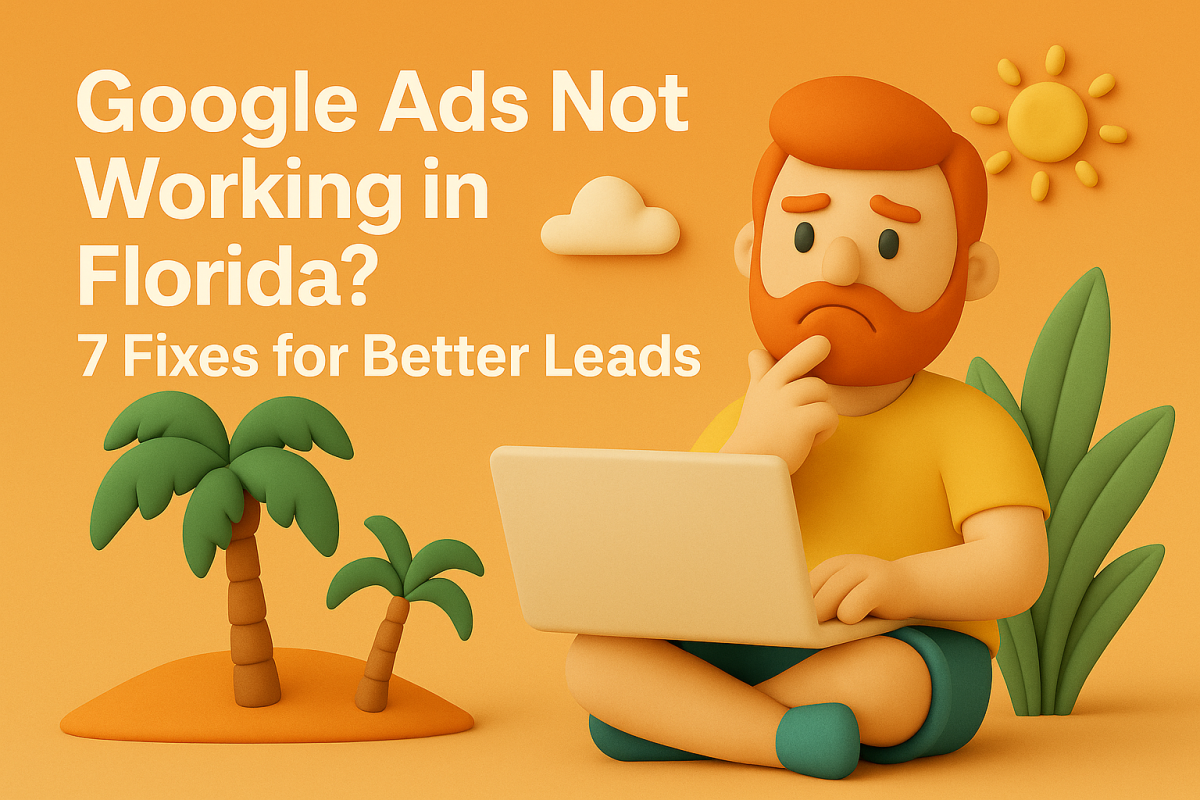
Google Ads Not Working in Florida? 7 Fixes for Better Leads
TL;DR:
- Florida service businesses often struggle with Google Ads that fail to deliver quality leads due to common issues like broad match keywords, poor location targeting, weak ad copy, subpar landing pages, missing tracking, no negative keywords, and misaligned seasonal budgets.
- This article explains 7 quick fixes: refine broad match keywords, tighten your geographic targeting, improve ad copy relevance, optimize landing pages for conversions, set up proper conversion tracking, add negative keywords, and adjust your budget for Florida’s seasonal trends.
- Real-world examples (HVAC, legal, pest control, roofing, medical) show how these fixes reduce wasted spend and boost lead quality. For instance, many industries in Florida see cost-per-click (CPC) ranging from $5 to $30, and cost per lead from $50 to $150+. Focusing your budget on the right clicks is crucial.
- The key takeaway is that fine-tuning your keywords, ads, and targeting will attract more local customers ready to buy, without necessarily spending more money.
- A reputable marketing agency can help you allocate budget smartly and prioritize quality leads, ensuring your Google Ads investment turns into real business results.
Running Google Ads for your Florida business but not seeing results? You’re not alone. Many service-based companies pour money into ads only to get a trickle of leads, or leads that go nowhere. The good news is, this isn’t a mystery. In most cases, a few specific issues are to blame. Below we break down seven common reasons your Google Ads might be underperforming in Florida and how to fix each one fast. These fixes will help you improve lead quality so you get more calls and inquiries from real potential customers, not tire-kickers or people outside your area. Want to skip the 3 minute (highly valuable) read & talk to an expert?  Book your free strategy session now Let’s dive into the most common fixes we see being needed:
1. Refine Broad Match Keywords for Relevance ✅
If you’ve been using broad match keywords, they could be a major culprit for poor lead quality. Broad match keywords tell Google it can show your ad on any search term loosely related to your keyword. This often means your ads pop up for queries that aren’t looking for your services. For example, a Miami HVAC company using broad match for “air conditioning repair” might get matched to searches like “air conditioner DIY fix” or “portable AC units.” In both cases, those searchers are not looking to hire a pro. These irrelevant clicks waste your budget (remember, in some Florida industries you might be paying $10 or more per click) and don’t result in leads. The fix: Switch to more precise keyword match types like Phrase Match or Exact Match for your core terms. Phrase match ensures the search includes your phrase (e.g. “AC repair in Miami”), and exact match targets only that specific search or close variants. This way, your ads show up for searches that closely align with what you actually offer. You can still use broad match sparingly to discover new keywords, but do so carefully. Monitor the search terms report and immediately add irrelevant searches as negatives (more on that below). By refining your keywords, you’ll attract fewer random clicks and more visitors who actually need your service, improving your cost per lead.
2. Tighten Up Your Geographic Targeting 📍
Florida businesses often serve specific areas and if your ads aren’t zeroed in on those areas, you’re paying for clicks that can’t turn into customers. One common oversight is targeting too broad a region (like all of Florida or even the entire U.S.) when your service area is just a city or county. Another issue is Google’s default location setting, which might show your ads to people interested in your location, not only those physically there. This means a person in New York searching “Orlando pest control” could see your ad even though they’re nowhere near Florida. The fix: Double check your location targeting settings in Google Ads. Set your campaigns to target “People in or regularly in your targeted locations” (instead of the default that includes “interested in”). Define your service area precisely, for example, target by specific counties, cities, or a radius around your business. If you’re a roofing contractor in Broward County, you might target Broward and maybe neighboring Palm Beach County, but not the entire state. Also consider excluding locations that you don’t serve to prevent accidental clicks from those areas. By honing in on your true market, every click is more likely to be a potential customer in Florida who you can actually help.
3. Improve Your Ad Copy to Attract the Right Clients ✍️
Your Google ad copy isn’t just about getting clicks; it’s about getting the right clicks. If your ads are too generic or unclear, you might attract all sorts of visitors, including those who aren’t a fit for your business. For instance, a legal ad that simply says “Affordable Lawyers Available Now” might draw in people with cases you don’t handle or who expect ultra-low fees. Or an ad for a medical clinic that doesn’t specify it’s a cosmetic procedure clinic could attract general health inquiries. In Florida’s competitive market, your ad needs to immediately communicate what you offer and who it’s for. The fix: Write clear, specific, and locally relevant ad copy. Include your service, unique selling points, and location in the headlines or description. For example, an Orlando HVAC company might use ad text like “24/7 Orlando AC Repair, Fast, Local Service” instead of a bland “HVAC Services Available”. A Miami family law firm could say “Miami Family Lawyer, 20+ Years Helping FL Families” to speak directly to its target audience. This kind of copy does two things: it makes your ad more appealing to the people you do want, and it discourages clicks from those you don’t. Also, incorporate a strong call-to-action (e.g. “Call for a Free Quote” or “Schedule a Consultation Today”) so serious prospects know what to do next. Well-crafted ad copy will pre-qualify your clicks, meaning you pay for visitors who are more likely to convert to real leads.
4. Optimize Your Landing Pages (Don’t Send Traffic to Just Anywhere) 💻
Clicking on your ad is only half the battle, the page those visitors land on can make or break whether they become a lead. If you’ve been sending ad traffic to a generic homepage or a slow, cluttered page, you’re likely losing potential customers fast. Florida consumers (like everyone) have short attention spans online. They’ll leave if they don’t immediately find what was promised in the ad or if the page is hard to use on mobile. For example, a Tampa pest control ad that lands on a homepage might force the user to hunt for the termite service info they wanted. That confusion can cost you a lead. Similarly, if a Jacksonville medical practice has a landing page with no clear contact form or phone number, users might not bother figuring out how to reach out. The fix: Create dedicated, user-friendly landing pages for your Google Ads campaigns. Make sure each page closely matches the ad and keyword theme. If your ad is about “Emergency Roof Repair in Miami,” the landing page should be all about emergency roof repair in Miami, with relevant details, trust signals (like local testimonials or credentials), and a prominent contact form or phone number. Keep the design clean, mobile-friendly, and fast-loading (many Floridians will be visiting from their phones while on the go). Also, highlight local elements: for instance, mention your service area on the page, include images or references that resonate with Florida customers (like a picture of a home in your city or a note about “serving Miami-Dade since 2010”). By optimizing landing pages to align with your ads, you’ll increase your conversion rate, meaning more of those clicks turn into actual calls or form submissions. Even a small bump in conversion rate (say from 5% to 10%) can halve your cost per lead, which is a huge win for your ad budget.
5. Set Up Proper Conversion Tracking 📈
It’s tough to improve lead quality if you aren’t tracking leads in the first place. Many small businesses run Google Ads without fully setting up conversion tracking, so they have no idea which clicks turn into calls, form fills, or sales. If that’s the case, Google’s optimization algorithms are flying blind, and you’re left guessing which keywords or ads are actually working. For instance, let’s say your Fort Lauderdale roofing company gets phone calls from your ads, but without tracking you might not connect the dots that those calls came from Google Ads. Or a Tampa dentist might be getting appointment requests through an online form, but if the form isn’t tracked as a conversion, it looks like the campaign isn’t delivering any results when it actually is. The fix: Implement conversion tracking for all your key lead actions. In Google Ads (and Google Analytics if you use it), set up conversion goals for things like: form submissions (e.g. “Contact Us” or appointment request forms), phone calls (use Google’s call tracking or a third-party call tracking number to capture calls from ads and from your website), and even chat inquiries if applicable. This way, you’ll know exactly how many leads your campaigns generate and which keywords or ads they came from. Tracking not only proves what’s working, but it also feeds Google’s smart bidding strategies. For example, if you switch to a Target CPA (cost per acquisition) bidding, Google will use the conversion data to focus on searches that are more likely to convert. Bottom line: you can’t improve what you don’t measure. With tracking in place, you might discover that one campaign has a $50 cost per lead while another is $150, invaluable info that lets you reallocate budget toward the better performers and improve overall lead quality.
6. Use Negative Keywords to Filter Out Junk Searches 🙅♂️
Negative keywords are your quality filter in Google Ads. If you’re not using them, you’re probably paying for a lot of irrelevant traffic. A negative keyword tells Google, “don’t show my ad if the search query contains this term.” This is crucial when you want to avoid certain audiences. For example, a Miami pest control company would want to exclude searches related to jobs or DIY (like “pest control careers” or “home pest control tips”) since those searchers aren’t looking to hire anyone. Similarly, a Fort Myers lawyer might add negatives for “free advice” or “pro bono” if they only want paying clients, or an Orlando HVAC contractor might negative out “window AC” if they only service central HVAC systems. The fix: Brainstorm and add negative keywords for terms that commonly waste your budget. A good practice is to regularly review your Search Terms report (which shows the actual searches that triggered your ads) and note any off-base queries. When you spot them, add those words as negatives. Common negative keywords for service businesses include words like “jobs”, “career”, “DIY”, “cheap” (if you’re a premium service), “free” (if you don’t offer free service), or names of locations you don’t serve. Over time, this filtering makes a big difference: your budget gets spent only on searches that have a decent chance of turning into leads. The result is often a lower cost per lead and far less time wasted on unqualified inquiries. Think of negative keywords as guardrails that keep your ads showing up only where they should.
7. Adjust Your Budget for Seasonal Trends 📊
Florida has its seasonal swings, and we’re not just talking about the weather. Consumer demand for many services fluctuates throughout the year. If your Google Ads budget is on autopilot (spending the same amount every month or day), you might be missing opportunities during peak season or overspending in slow periods. For example, an HVAC company in Florida will get far more search volume for AC repair in the summer. If they don’t raise their budget or bids during a July heatwave, they could run out of daily budget by noon and miss out on many hot leads. On the flip side, that same budget in cooler winter months might be more than needed, or should be redirected to heater maintenance services. Another example: a South Florida roofing contractor might see spikes in searches after a major storm or during hurricane season. That’s the time to pour more fuel on the fire. If you ignore these patterns, you either leave money on the table during high-demand times or waste money when demand is low. The fix: Align your budget and bidding strategy with seasonality. Review your campaign performance by month or use tools like Google Trends to anticipate when your customers are searching most. Increase budgets (and consider raising your target CPA or manual bids if you use them) during high-demand months to ensure your ads stay visible all day and capture as many quality leads as possible. During slower periods, you can dial back spending or focus on more niche services. The goal is to spend your money when people are most likely to need you. A good Florida marketing agency will often plan an annual calendar with the client to ramp up certain campaigns at key times (for instance, promoting plumbers heavily just before the holidays when house guests cause plumbing issues, or AC services at the start of summer). By being strategic with seasonal budget adjustments, you’ll improve your lead volume and quality when it counts, without overspending when interest wanes.
A Smart Agency Can Supercharge Your Budget & Lead Quality 🔥
You’ve seen the fixes, now here’s why partnering with the right marketing agency (like us 😉) can make them even more effective. A good agency will treat your budget as if it were their own money. That means they’ll constantly monitor and tweak all the factors above: keyword matches, locations, ad messaging, landing pages, tracking data, and negative keywords. Crucially, they’ll also advise you on budget allocation, how much to invest, and when, to maximize returns. For a Florida service business, that could mean suggesting a higher spend in peak season and a conservative approach in the off-season, or shifting budget to the campaigns and keywords that produce the best leads. An experienced agency focusing on lead quality won’t just chase more clicks or vanity metrics. They’ll dig into which leads turned into real customers. For example, they may notice that although one campaign is getting lots of conversions, those leads rarely turn into sales, so they’ll adjust strategy to focus on the sources that do bring profitable customers. They should also provide clear reporting, so you know exactly what your cost per lead is in each campaign and how those leads are performing. The right marketing partner will continuously optimize your Google Ads with an eye on quality, not just quantity. They can quickly implement the fixes above and keep fine-tuning them as the market changes. The result? You waste less money, you get better leads, and your advertising budget goes toward driving actual business growth. Whether you handle your Google Ads in-house or hire experts to manage it, the focus should always be on smart budget use and high-quality leads, that’s the formula for turning “Google Ads aren’t working” into “Google Ads are our best investment.” If your business is ready to work with an agency and scale, Book your free strategy session now to meet with one of our experts.
FAQ ❓
Q: Why are my Google Ads not generating good leads in Florida? A: If your Google Ads aren’t bringing in quality leads, it’s usually due to one or more common issues. You might be using overly broad keywords that attract irrelevant clicks, or your ads could be reaching people outside your service area. Weak ad copy and poor landing pages can fail to convert interested visitors. Additionally, not having conversion tracking or negative keywords set up can make it hard to filter out unqualified traffic. All these factors can make it seem like “Google Ads aren’t working” when in reality the campaign isn’t properly tuned yet. Q: How can I target local customers more effectively with Google Ads? A: To reach local customers, use Google’s location targeting to focus on the specific areas you serve. Set your campaigns to target people who are actually in your service region (for example, a radius around your city or specific Florida counties). Include local identifiers in your keywords and ad copy (like city names or “Florida”) so your ads clearly show you’re a local provider. This way, your budget goes toward clicks from people who live or work in your area and are more likely to become customers. To learn more about local marketing, read our blog “WTF Are Geo-Targeting Ads” Q: What is a good cost per lead for service businesses in Florida? A: Cost per lead (CPL) can vary widely by industry, but a reasonable benchmark for many Florida service businesses is somewhere between $50 and $150 per lead. Less competitive services (say, routine home maintenance) might see lower CPLs, while highly competitive sectors (like legal or specialized medical services) could see higher costs. The main goal is to ensure that the leads you acquire at that cost are turning into paying customers. If a $100 lead results in a $5,000 job, it’s money well spent. Always track your CPL and adjust your campaigns if costs climb without an improvement in lead quality. To read more about marketing costs, we have two blogs you might be interested in linked below. Check them out to learn more!
Q: Why are negative keywords important in Google Ads? A: Negative keywords are essential because they prevent your ads from showing on searches that aren’t relevant to your business. By adding negatives (like “jobs”, “free”, “DIY”, or other services you don’t offer), you filter out people who are unlikely to become customers. This saves your budget for the clicks that matter. Negative keywords cut out the noise, ensuring your ads reach the searchers who need your service and improving overall lead quality. Q: Should I hire a marketing agency to manage my Google Ads? A: If you’re not satisfied with your Google Ads performance or you’re unsure how to fix the issues, a marketing agency can be a smart investment. An agency with experience (especially one familiar with the Florida market) will know how to optimize keywords, targeting, and ad copy, and can manage your campaigns day-to-day. They’ll also track results and adjust your budget for peak times, focusing on getting you quality leads. While it comes at a cost, the expertise can pay for itself by improving your return on ad spend and freeing you up to focus on running your business.
 If you’d like expert eyes on your campaigns, our team at J. Oliver Advertising can help turn insights into results. Book your free strategy session now J. Oliver Advertising
  Scaling Smarter Starts Here!
  Instagram
  5 Star Reviews